


Yann Furic
B.B.A., M. Sc., CFAMD
Gestionnaire principal, répartition d’actifs et stratégies alternatives
August 2026 was marked by persistent geopolitical tensions, rising budget deficits and increased demand from investors for higher yields.
Diversification of market returns: a positive sign
The Bloomberg global growth indicator still projects growth of 3% this year and 3.1% in 2027, which is positive. Global PMI indicators remained in expansionary territory and even improved slightly worldwide.
Corporate earnings met expectations in the second quarter, and forecasts for the next six months confirm their continued growth. Against this backdrop, stock markets continue to benefit from a boom partly driven by infrastructure spending on the development of artificial intelligence (AI). Economic growth, though weak, is spreading across several sectors, which is positive for the markets.

Key issues: inflation and energy
Persistent inflation in the United States and the impact on energy prices caused by the conflict with Iran are keeping price growth at a level that is too high. Several central banks have either resumed raising rates or are seriously considering doing so. The latest decision of the Bank of Canada (BoC) was to keep its policy rate unchanged, but Governor Tiff Macklem’s remarks were seen as a warning of an upcoming rate hike if energy costs remain high.
In this regard, efforts to minimize the impact of the conflict with Iran and the closure of the Strait of Hormuz on oil prices have yielded positive results: These include Saudi Arabia’s use of the east-west pipeline to reach Red Sea ports, increased U.S. production, as well as reduced purchases by China and the passage—albeit limited—of certain oil tankers through the strait.
Nevertheless, the price of diesel continues to rise sharply. This fuel is used primarily in the agricultural and transportation sectors; consequently, the repercussions of this cost surge are significant in terms of inflation. In the context of the conflict between Ukraine and Russia, several Russian refineries have been attacked by Ukrainian forces, which has limited Russian diesel exports. It should also be noted that the ships carrying these petroleum products are smaller than those carrying only crude oil. In terms of global trade, this means a significantly higher number of round trips for these ships through the Strait of Hormuz—which remains highly risky—to transport diesel from Middle Eastern refineries to global markets.
Controlling inflation: what is the role of central banks?
It is difficult for a central bank seeking to influence short-term interest rates to contain inflationary pressures when they stem from a supply shock such as the global reduction in oil availability we are currently experiencing. The goal of such an institution then becomes to minimize the pass-through of these rising costs to the prices of other goods and services.
Like the Bank of Canada, the U.S. Federal Reserve (Fed) is also facing persistent and higher inflation, while the country’s labour market continues to hold up. For the Fed’s new governor, Kevin Warsh, returning to a 2% inflation rate is a priority: this determination could lead him to try to avoid raising rates as the midterm elections approach, in order to avoid accusations of electoral interference.
The Bank of Japan (BoJ) is also facing inflationary pressures and must raise interest rates, at the risk of triggering a devaluation of its currency.
The bond situation
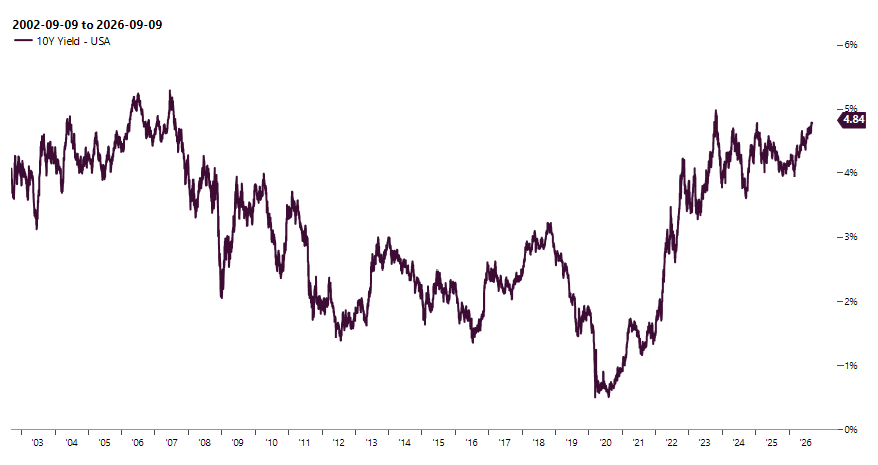
In the United States, yields on longer-term bonds (2-, 5-, or 10-year) are currently at levels not seen in nearly 20 years.
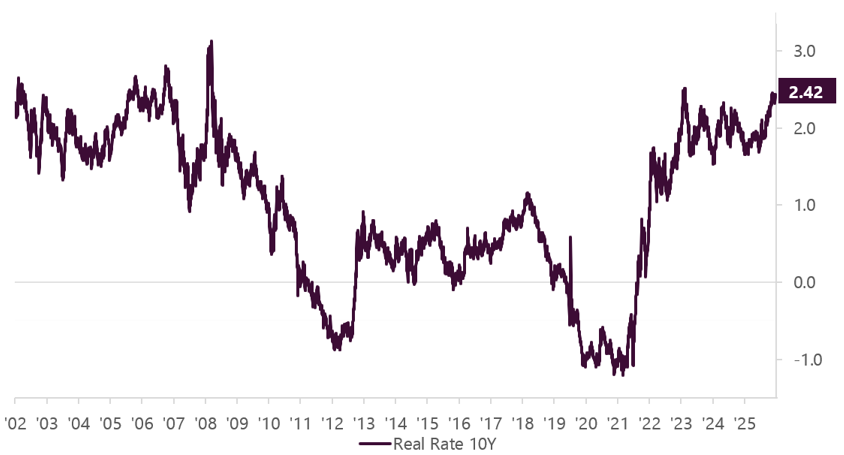
Before the 2008 financial crisis, bond investors demanded not only higher yields to protect themselves against anticipated inflation, but also a higher return that would outpace inflation. Currently, the yield on 10-year U.S. Treasuries has reached levels last seen before the financial crisis.
The charts below show that, as of September 8, 2026, investors purchasing a 10-year U.S. Treasury bond are seeking a return that is 2.42% higher than the inflation rate currently estimated at 2.4% per year for the next ten years. This demand for additional return is in line with investors’ past expectations, but it significantly increases government spending, as U.S. public debt is now much higher than it was 20 years ago, even though gross domestic product (GDP) has also increased.
Current yield on 10-year U.S. Treasury bonds
From August 9, 2002 to August 9, 2026
Real return on 10-year U.S. Treasury bonds
From August 9, 2002 to August 9, 2026
Direct effects of interest rate hikes
Higher interest rates mean it may be more difficult to become a homeowner or, in the case of businesses, to deploy capital. For now, major tech companies are moving forward with their infrastructure investment plans, and the U.S. economy continues to grow. The U.S. job market remains stable in an environment where hiring is low, but so are layoffs.
Looking at U.S. consumers, it’s clear that they are not a homogeneous group and that some segments of the population are finding it harder to absorb rising energy and food prices. Nearly 70% of the U.S. economy is directly linked to consumer spending: significant and prolonged weakness in this sector could have negative effects on the economy.
In Canada, the latest GDP numbers showed growth during the second quarter as well as an upward revision for the previous quarter. Canada has thus managed to avoid a technical recession, but the impact of U.S. tariffs could have negative repercussions on the economy. It should be noted that in Canada, higher prices for raw materials are positive for the economy, as well as for several sectors of the S&P/TSX stock index.
Europe posted better-than-expected growth in the second quarter. However, this growth remains weak in absolute terms and has been negatively impacted by rising energy costs.

Jobs: losses and gains
Job creation in Canada was weaker than expected, with a loss of 41,700 jobs, primarily full-time positions. Previously, July had seen strong job creation, with 75,100 jobs added, mainly full-time positions. Wage growth also slowed from 3% to 2%, bringing it in line with the Bank of Canada’s inflation target. The recent trade dispute will create tensions in the Canadian labour market, but its full impact remains to be seen.
South of the border, the employment situation was positive, with 162,000 jobs added, exceeding the expected 55,000. For several months now, the United States has been experiencing stable but weak job growth. Overall, wage inflation at 3.1% and a stable labour market are factors pointing toward a rate hike by the Fed.
U.S.-Iran conflict getting bogged down
The conflict between the United States and Iran continues to make headlines daily and is becoming more entrenched. The price of oil remains a good indicator, having fluctuated between US$90 and US$110 from March through August.
Since China is Iran’s largest trading partner but also wants to maintain good relations with other countries in the region, it continues to advocate for a diplomatic solution. During the meeting scheduled for September 24 in Washington between the U.S. president and his Chinese counterpart, it is highly likely that the issue of fully reopening the Strait of Hormuz will be among the topics discussed.
CUSMA negotiations: the instability continues
July 1, 2026, has passed, and no partner has terminated the agreement; it is therefore understood that for the next ten years, an annual negotiation process will be in effect. If no agreement is reached during this decade, CUSMA will lapse in 2036.
The most negative aspect of these annual negotiations is that companies in the countries involved cannot anticipate future developments: it is therefore likely that most of them will delay or cancel their development projects. This applies to all three partners.
Financial market performance last month
OVERVIEW OF GLOBAL EQUITY MARKETSAll percentages are in Canadian dollars. |
||||
|
Country |
Index |
Return* |
Change |
Year-to-date return in 2026 |
|
Canada |
S&P/TSX |
3.10% |
|
16.01% |
|
United States |
S&P 500 |
1.1% |
|
14.42% |
|
|
Nasdaq |
2.76% |
|
15.19% |
|
International stock markets |
EAFE |
0.79% |
|
15.10% |
|
Emerging markets |
|
2.15% |
|
25.49% |
|
China |
MSCI China |
-1.52% |
|
-6.59% |


*The return shown is the total return, which includes the reinvestment of income and capital gains distributions
Source : Morningstar Direct.
RETURN ON CANADIAN BONDS |
|
| Index | Return from January 1 to August 31, 2026 |
| FTSE Canada Universe Bond Index | 0.44% |
Source : Morningstar Direct
Data influencing the markets
CANADA |
UNITED STATES |
Recession Indicator |
|
Moderate |
Moderate |
Policy Rates |
|
2.25% |
3.50% – 3.75% |
|
No change was announced by the Bank of Canada on September 2, 2026. The BoC remains optimistic about GDP growth in 2026. |
The U.S. Federal Reserve kept its policy rates unchanged on July 29, 2026. Uncertainty surrounding inflation and employment persists and is compounded by inflationary pressures stemming from the conflict with Iran. |
Employment Situation |
|
|
Jobs lost: 41,700 Expectations: gain of 10,000 |
Jobs gained: 162,000 Expectations: gain of 55,000 |
|
|
|
|
Wage growth: 2.0% Expectations: 3.0% |
Wage growth: 3.1% Expectations: 3.1% |
|
Unemployment rate: 6.4% Expectations: 6.4% |
Unemployment rate: 4.1% Expectations: 4.1% |
Inflation |
|
|
August: 3.0% Change: 0.0% |
August: 4.3% Change: 0.0% |
Overall, what are the economic indicators telling us?
Benchmark rates (Canada, Europe and the United States) 
- U.S. Federal Reserve: upward pressure.
- Bank of Canada: no change in rates, with close monitoring of the consequences of the conflict in Iran. A possible rate hike by year end.
- European Central Bank (ECB): rate hike at its June meeting and awaiting future economic data. Expectations of one or two rate hikes for the rest of the year due to the conflict in Iran and its impact on energy prices.
Global Purchasing Managers’ Index
- Manufacturing segment: positive, with 22 of the 30 countries in this segment posting a reading above 50 (expansion).
- Services segment: continues to hold up.
- Global inflation rate: fears of rising inflation due to the conflict with Iran and energy prices. General trend: no change or an increase in rates.

Factors to watch
- Conflict with Iran: The global tensions it is causing, and especially the impact on traffic in the Strait of Hormuz, will have an impact on corporate earnings. The longer the conflict drags on, the greater its repercussions will be, but supply chains are increasingly adjusting.
- Deregulation in various industries in the United States: this should help maintain economic growth and encourage investment. Other countries, such as Canada, will have to follow suit or risk losing competitiveness.
- Trade tensions: Supported by the indiscriminate use of tariffs, they could cause an economic slowdown and increase inflation, resulting in an episode of stagflation, the most negative economic scenario. The trade agreement between Canada, the United States and Mexico (CUSMA) is now in the annual renegotiation phase, which could create a climate of uncertainty in terms of corporate investment.
- Inflationary scenarios: If they result in keeping yields on five-to-ten-year maturities at high levels, they should be avoided at all costs, as they would slow business investment and the reshoring of production lines to the United States.
- Geopolitical uncertainty: Conflict between the United States and Iran, the Russia-Ukraine war, regional conflicts in the Middle East, tensions between the U.S. and China, possible annexation of Taiwan by the Chinese government, return of the Monroe Doctrine in the United States.
fdp tactical views – August 2026
- We maintained the equity weighting in the tactical allocation strategy.
- We prefer stocks to corporate bonds, whose spreads remain historically tight.
- Economies continue to grow. Large companies are generally reporting solid earnings, which is keeping stock markets in positive territory.
- In the fixed income component, we maintained our holdings of North American and emerging market bonds.
We continue to favour stocks in developed countries and focus on risk management.
To learn how our funds performed:
Senior Manager, Asset Allocation and Alternative Strategies
Data source : Bloomberg
The opinions expressed here and on the next page do not necessarily represent the views of Professionals’ Financial. The information contained herein has been obtained from sources deemed reliable, but we do not guarantee the accuracy of this information, and it may be incomplete. The opinions expressed are based upon our analysis and interpretation of this information and are not to be construed as a recommendation. Please consult your Wealth Management Advisor.