Yann Furic
B.B.A., M. Sc., CFA®
Senior Portfolio Manager, Asset Allocation and Alternative Strategies
October was marked by significant fluctuations in the AI ecosystem. While North American stock indices had reached new highs at the beginning of the month, concerns about the financial results of major technology companies and the duration of the conflict with Iran caused them to fall, with the exception of the Canadian market index, which has greater exposure to banks and oil.
A generally positive atmosphere, despite everything
The global growth indicator of the Organization for Economic Cooperation and Development (OECD) continues to forecast growth of 3.1% in 2027, which is positive. Global PMI indicators remained in positive territory, but they did weaken somewhat.
- Corporate earnings met expectations in the 3rd quarter, but it was the outlook for future sales and profits that weighed on U.S. stock markets. For 2027, corporate earnings forecasts are expected to rise by 13.1%
- Economic growth, although weak, is currently spreading to several sectors, which is a positive development for the markets.
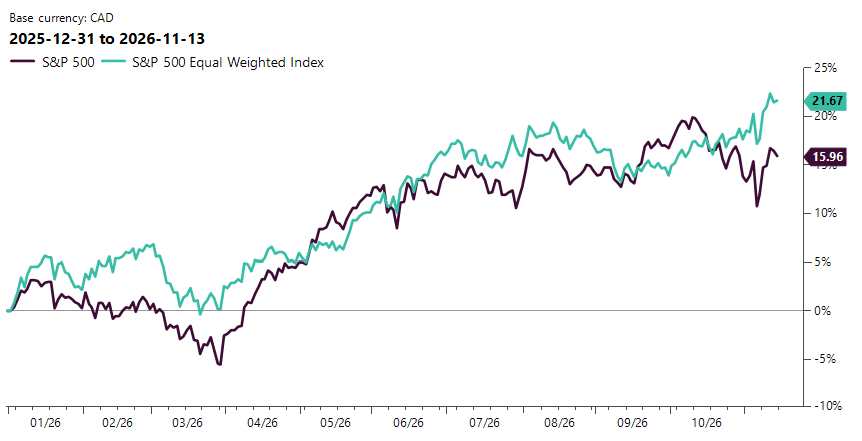
The following chart illustrates a situation that has been observed for several weeks: the S&P 500 Index—in which companies’ weightings are based on their market capitalization—is significantly lagging the S&P 500 Equal-Weighted Index, in which each of these same 500 companies has an equal weighting. This trend confirms that other sectors are taking over the lead from the “Magnificent Seven”—an encouraging sign that points to greater diversification.
Performance of the S&P 500 and S&P 500 Equal-Weighted Indices
Government bond yields
Since the beginning of the year, 10-year yields have risen sharply, but in October they declined, driven in part by investors seeking safer assets in light of recent stock market turmoil, as well as by yields that were more attractive than those of recent years.

Key issues: inflation and energy, once again
Persistent inflation in the United States and the impact on energy prices caused by the conflict with Iran are keeping price growth too high. Since the midterm elections, there has been little interest in the United States in launching major military operations in Iran, which may explain the drop in oil prices.
Reports from the Middle East seem to indicate that the volume of oil exported has returned to February levels, but the logistical aspect of transportation is more complicated and, above all, more expensive, which is keeping prices high. The price of diesel, which remains exorbitant, is driving up costs across various modes of transportation and in agriculture-related activities, leading to higher prices for all consumers.
U.S. midterm elections
On November 3, one-third of the U.S. Senate and the entire House of Representatives were up for election. The markets anticipated a victory for the Democrats, who were projected to win a majority in the House of Representatives and possibly a majority in the Senate, albeit short of the 60 senators needed to prevent filibusters.
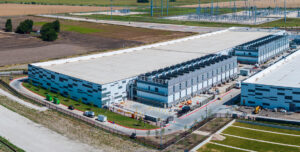 As a general rule, markets react to the unexpected. The scale of the Democratic victory was reflected in the reshuffling of key positions in several U.S. states, notably in the election of a Democratic governor in Texas. In this specific case, fears of a halt to data centre construction weighed heavily on AI companies. In the days following her election, the new governor of Texas stated that projects already underway would not be suspended, but that future projects could face delays. Other states could then attract these same projects to their territories, but it is still too early to determine the extent of these shifts.
As for the presidency, the midterm election results do not alter the current president’s authority over U.S. foreign policy and most tariff policies. However, the Democrats’ new control of Congress means that they hold the purse strings of the Treasury, and any presidential initiative requiring funding will need their approval. The Constitution also stipulates that any declaration of war must be approved by Congress. The officials elected on November 3 will take office on January 3, 2027.
Jobs: losses and gains continue
Once again in October, job creation in Canada was weaker than expected, with a loss of 4,700 jobs, primarily in the private service sector, affecting full-time workers and resulting in a loss of 52,500 jobs. Meanwhile, the public sector added 49,600 jobs. Alberta saw the highest job losses, with 24,300 positions cut. Wage growth slowed from 2.3% to 2.0%.
South of the border, the employment situation was positive, with 165,000 jobs added—significantly higher than the expected 70,000. The previous month’s data were also revised upward, from 29,000 to 60,000 jobs added. For several months now, the United States has been experiencing stable but weak job growth. Overall, wage inflation at 3.1% and a stable job market are factors militating in favour of a rate hike by the U.S. Federal Reserve (Fed) by the end of the year, following a pause in October.
U.S.-Iran conflict: nothing has been resolved yet
The conflict between the United States and Iran continues to make daily headlines. The price of oil remains the key indicator of the conflict’s status.
Financial market performance last month
OVERVIEW OF GLOBAL EQUITY MARKETSAll percentages are in Canadian dollars. |
||||
|
Country |
Index |
Return* |
Change |
Year-to-date return in 2026 |
|
Canada |
S&P/TSX |
3.10% |
|
16.01% |
|
United States |
S&P 500 |
1.10% |
|
14.42% |
|
|
Nasdaq |
2.76% |
|
15.19% |
|
International stock markets |
EAFE |
0.79% |
|
15.10% |
|
Emerging markets |
|
2.15% |
|
25.49% |
|
China |
MSCI China |
-1.52% |
|
-6.59% |


*The return shown is the total return, which includes the reinvestment of income and capital gains distributions
Source : Morningstar Direct.
RETURN ON CANADIAN BONDS |
|
| Index | Return from January 1 to October 31, 2026 |
| FTSE Canada Universe Bond Index | 0.44% |
Source : Morningstar Direct
Data influencing the markets
CANADA |
UNITED STATES |
Recession Indicator |
|
Moderate |
Moderate |
Policy Rates |
|
2.25% |
3.75% – 4.00% |
|
The Bank of Canada announced a rate hike on October 28, 2026. The BoC remains optimistic about GDP growth in 2026. |
The U.S. Federal Reserve kept its policy rates unchanged on October 28, 2026. Uncertainty surrounding inflation and employment persists and is compounded by inflationary pressures stemming from the conflict with Iran. The market is anticipating another rate hike in December. |
Employment Situation |
|
|
Jobs lost: 4,700 Expectations: gain of 15,000 |
Jobs gained: 165,000 Expectations: gain of 70,000 |
|
|
|
|
Wage growth: 2.0% Expectations: 2.1% |
Wage growth: 3.1% Expectations: 2.9% |
|
Unemployment rate: 6.7% Expectations: 6.5% |
Unemployment rate: 4.1% Expectations: 4.2% |
Inflation |
|
|
August: 3.1% Change: 0% |
August: 0.4% (monthly) Change: -0.2% (monthly) |
Overall, what are the economic indicators telling us?
Policy rates (Canada, Europe and the United States) 
- U.S. Federal Reserve: upward pressure and likely a rate hike—possibly as high as 0.50%—at the upcoming meeting on December 9.
- Bank of Canada: rate hike in October and keeping a close eye on the impact of the conflict in Iran. Another hike is possible by the end of the year.
- European Central Bank: rates held steady at the October meeting, with the bank awaiting future economic data. Expectations of one rate hike for the rest of the year due to the conflict in Iran and its impact on energy prices.
Global Purchasing Managers’ Index
- Manufacturing segment: positive, with 20 of the 30 countries in this segment posting a reading above 50 (expansion).
- Services segment: continues to hold up.
- Global inflation rate: fears of rising inflation due to the conflict with Iran and energy prices. General trend: no change or an increase in rates.

Factors to watch
- Conflict with Iran: The global tensions it is causing, and especially the impact on traffic in the Strait of Hormuz, will have an impact on corporate earnings. The longer the conflict drags on, the greater its repercussions will be, but supply chains are increasingly adjusting.
- The deregulation trend in various industries in the United States could slow as a result of a Congress now controlled by the Democrats.
- Trade tensions: Supported by the indiscriminate use of tariffs, they could cause an economic slowdown and increase inflation, resulting in an episode of stagflation, the most negative economic scenario. The trade agreement between Canada, the United States and Mexico (CUSMA) is now in the annual renegotiation phase, which may create ongoing uncertainty regarding business investment.
- Inflationary scenarios and large deficits: If they result in keeping yields on five-to-ten-year maturities at high levels, they should be avoided at all costs, as they would slow business investment and the reshoring of production lines to the United States. This seems to be increasingly reflected in global yield curves.
- Geopolitical uncertainty: Conflict between the United States and Iran, the Russia-Ukraine war, regional conflicts in the Middle East, tensions between the U.S. and China, possible annexation of Taiwan by the Chinese government, return of the Monroe Doctrine in the United States.
fdp tactical views – October 2026
- We maintained the equity weighting in the tactical allocation strategy. We remain overweight stocks, but the rise in bond yields over the past several weeks has made bond returns more attractive.
- Economies continue to grow. Large companies are generally reporting solid earnings, which is keeping stock markets in positive territory. This profit growth is helping stock markets hold steady, despite the overall rise in medium- and long-term interest rates.
- In the fixed income component, we maintained our holdings of North American bonds.
We continue to favour stocks in developed countries and focus on risk management.
To learn how our funds performed:
Senior Manager, Asset Allocation and Alternative Strategies
Data source : Bloomberg
The opinions expressed here and on the next page do not necessarily represent the views of Professionals’ Financial. The information contained herein has been obtained from sources deemed reliable, but we do not guarantee the accuracy of this information, and it may be incomplete. The opinions expressed are based upon our analysis and interpretation of this information and are not to be construed as a recommendation. Please consult your Wealth Management Advisor.